
At Gevo, we believe the transition to a net-zero future must be grounded in transparency and the best available science. For over a decade, the conversation around biofuels and Carbon Dioxide Removal (CDR) has been overshadowed by a complex concept known as Indirect Land Use Change (iLUC).
If you follow the conversation around biofuels, you’ve almost certainly heard the objection: “Doesn’t growing corn for fuel take food off the table and force deforestation elsewhere?”. It is a valid question, and it can happen, but the answer often relies on outdated assumptions rather than real-world data. Here is what the data says about corn ethanol today, global markets, and how we are actively solving for sustainability.
Key takeaways
- Despite ethanol’s growth, U.S. crop acreage has never exceeded its 2007 baseline — the EPA found it fell from 402 million acres in 2007 to 382 million in 2025.
- Between 2005 and 2015, U.S. ethanol production more than tripled (16.4 to 53.1 billion liters), yet corn-harvested land grew only slightly, from 30 to 33 million hectares (IEA Bioenergy).
- Rising yields did the heavy lifting: corn output climbed from 9.3 to 11.6 tonnes per hectare over that decade, letting the industry triple fuel output without expanding its footprint (IEA Bioenergy).
- The most recent U.S. modeling, by Argonne National Laboratory for the 45Z tax credit, put corn ethanol’s indirect land use change (iLUC) at just 5.7 gCO₂e/MJ — a low-risk figure, though global estimates still range widely from about 5 to 100 g/MJ.
- Gevo sources only from land farmed for 20+ years (per Puro.earth methodology).
What’s the difference between direct and indirect land use change?
Direct Land Use Change is straightforward and measurable. It occurs when a farmer cuts down a forest or plows a native grassland to plant corn. This is easily measurable via satellite imagery and is directly attributable to that specific farmer.
Indirect Land Use Change is much “fuzzier.” It attempts to measure market-mediated effects across the global economy. The theory goes that if a U.S. farmer sells crops to an ethanol plant instead of a food company, that food company still needs corn. They might switch to another feedstock or outbid others, potentially triggering a farmer in Indonesia or Brazil to cut down a rainforest to meet the remaining global demand.
As our Senior Sustainability Analyst noted, “All iLUC is really somebody else’s DLUC.” It attributes the decisions of actors across the globe back to the biofuel producer.
What did past iLUC predictions get wrong?
When early biofuel policies like the Renewable Fuel Standard (RFS) began in the mid-2000s, they were built on models predicting two major negative outcomes: a massive expansion of U.S. crop acreage and global food insecurity.
After nearly 20 years of data, these predictions have largely not come true for U.S. markets.
- No Acreage Explosion: Since 2010, the EPA has assessed crop acreage annually. They have never found that overall U.S. crop acreage exceeded the 2007 baseline, despite the industry’s growth. In fact, the EPA stated crop acreage decreased from 402 million acres in 2007 to 382 million acres in 2025.
- Stable Food Supply: Despite the growth of the ethanol industry, corn exports and corn used for food have not decreased. In fact, domestic food use has increased slightly.
Data from the U.S. EPA’s national GHG inventory also show that far more cropland in the US is being converted to other land types (grassland, human settlement, forest, and wetlands) than the other way around, demonstrating that the risk of US crop production converting natural habitat is low:
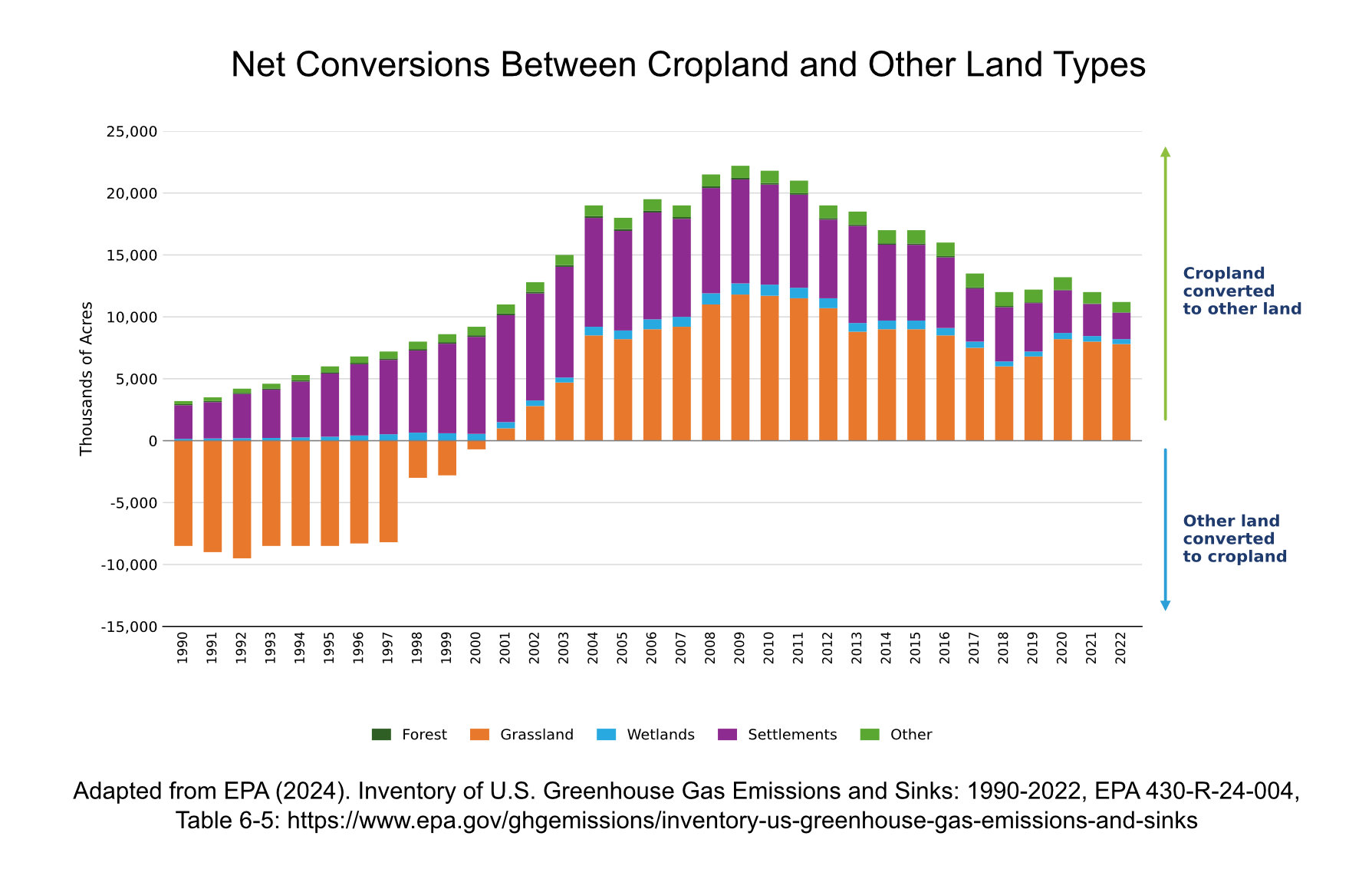
DID YOU KNOW: Conversion from farmland to other sources is more common in the U.S. than the other way around. Between 2001 and 2016, approximately 11 million acres of farmland and ranchland alone were converted for residential areas. Urban Sprawl is the largest land use change drivers according to the U.S. Geological Survey and the EPA’s Report on the Environment.
Why did an increase in corn production not lead to land-use change?
The primary reason land-use change didn’t happen as predicted is that farmers became dramatically more efficient. Findings from IEA Bioenergy provide the hard proof for the decade between 2005 and 2015:
- Production Tripled: U.S. ethanol production more than tripled, jumping from 16.4 billion liters to 53.1 billion liters.
- Total Supply Grew: To support this, total corn production increased by about 25%.
- The Yield Skyrocket: While land harvested specifically for corn increased only slightly from 30 to 33 million hectares–the efficiency of that land skyrocketed. Farmers grew 11.6 tonnes of corn per hectare in 2015, compared to just 9.3 tonnes in 2005. Improvements in technology and access to farm data were enabling optimizations such as more precise fertilizer or seed application that not only increased yields, but improved soil health and resilience to droughts and floods.
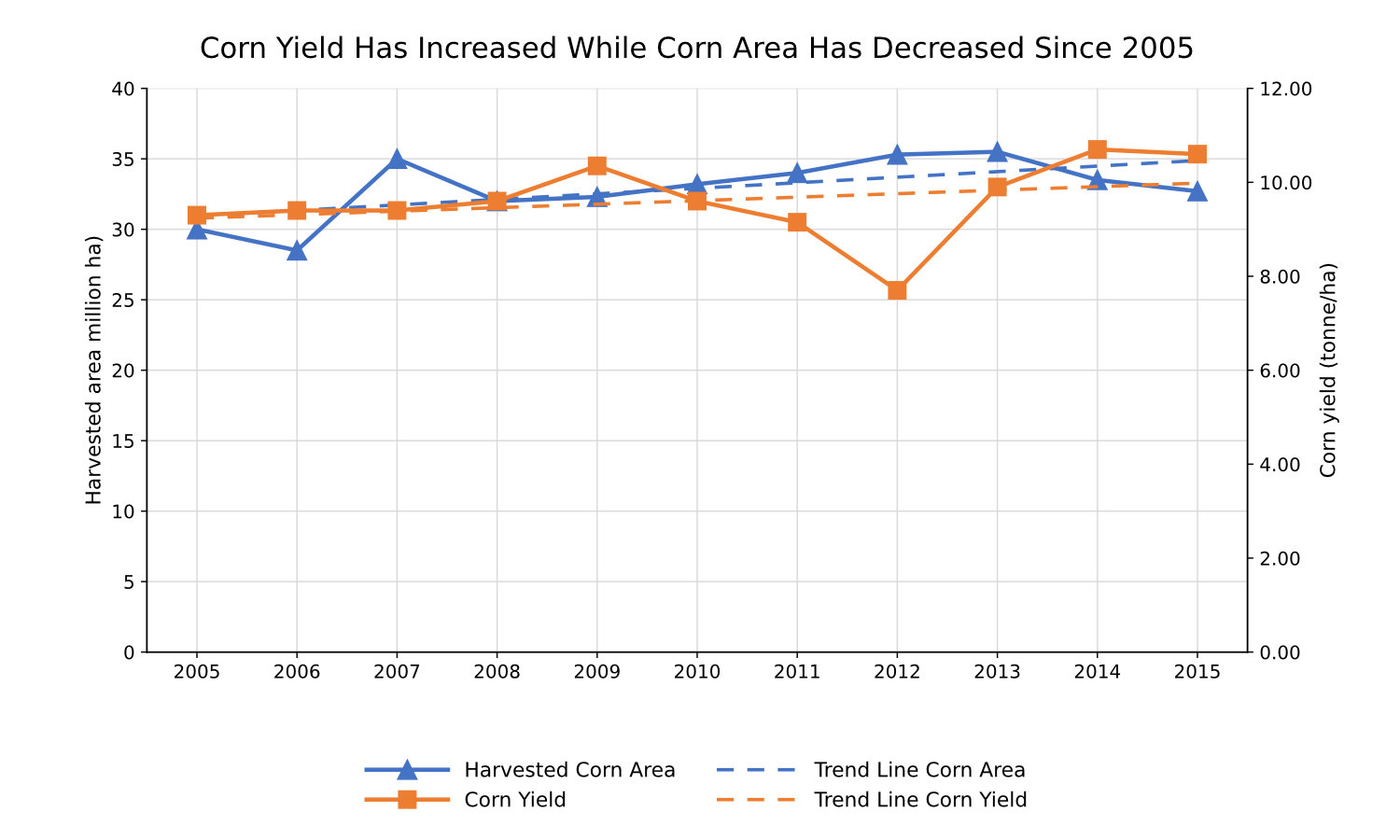
Image source: IEA Bioenergy Report, 2023
This technological leap allowed the industry to triple its fuel output while the overall U.S. agricultural footprint remained stable. In fact, even with the growth of corn ethanol, the total U.S. crop acreage actually saw a slight decrease between 2005 and 2015 and has never exceeded the 2007 baseline. When you grow significantly more on nearly the same amount of land, you remove the pressure for expansion, effectively shielding global ecosystems from the “domino effect” modelers once feared.
What About Changes in Global “Price Signals”
Now, let’s look past the acreage stats to consider the pricing signal. The theory is that if ethanol keeps global corn prices high, it encourages land clearing internationally.
However, market data shows that the “price signal” is a temporary market adjustment, not a permanent driver of expansion.
- The Decoupling: Global corn prices are driven more by weather and oil prices than by fuel demand. For instance, a 2012 drought caused corn prices to skyrocket and in 2015 they plummeted by 50% even while ethanol production remained at all-time highs.
- Yield Responsiveness: When prices rise, the first response isn’t to clear a forest; it’s to invest in better seeds and precision technology to increase the yield on existing land. This is exactly what happened in the U.S. soybean and corn sectors over the last two decades.
Why are there different perspectives on iLUC?
Understanding and mitigating land use change is vital to achieving global climate goals. However, it remains highly complex due to a multitude of driving factors. The key drivers behind land use change range from shifting climate patterns and droughts to national policies and the fluctuating prices of competing crops. Furthermore, because commodities like corn serve as ‘drop-in’ components for thousands of products—including fuels, beverages, and bioplastics—the economic and environmental variables involved are virtually endless.
The reality is it’s nearly impossible to have certainty on the impact of a singular product across this landscape. Despite challenges, rigorous efforts must be made to understand and account for iLUC to protect against adverse outcomes. So how are markets doing it?
The U.S. was among the first to model iLUC and account for it in the form of estimated emissions that result from indirect land use change. The most recent modeling was done by Argonne National Lab for the purposes of the 45Z Clean Fuel Production tax credit assessments and found an iLUC value of just 5.7 gCO2e/MJ, which indicates low risk. The rest of the world has reached different conclusions on how to account for it. This is what we call Model Divergence. It highlights that iLUC is a research hypothesis, not a fixed physical constant.
How is iLUC calculated and applied in the U.S.?
In the U.S., particularly within the California Air Resources Board (CARB) and the EPA, regulators often try to calculate a specific, numeric “iLUC score” to add to a biofuel’s carbon footprint. These models, like GTAP, attempt to simulate the entire global economy to guess a number. However, these scores vary wildly—from as high as 100 g/MJ to as low as 5 g/MJ—proving how uncertain the math truly is.
How is iLUC calculated and applied outside of the U.S.?
Other major economies have realized that trying to put a single number on a “theoretical ripple” is scientifically unstable.
- The EU: Under the Renewable Energy Directive (RED II), Europe has shifted toward a Risk Assessment model. Instead of guessing a numeric score, they look at actual expansion rates. If a crop (like palm oil or soy) is historically linked to clearing high-carbon lands, it is labeled “high iLUC-risk” and phased out.
- Brazil and Japan: Many regions focus on direct criteria—ensuring the fuel was grown on land that wasn’t recently forest—rather than using a global economic model to penalize local farmers.
Gevo’s Position: Verifying What We Can Control
At Gevo, we believe land use change is real – it should be monitored and measured so markets can respond and mitigate it appropriately. We monitor iLUC research and rely on the latest models to inform our carbon accounting. But, as a company working directly with farmers and their product, most of our focus is where we have the most control: Direct Land Use Change.
We are actively decoupling our production from land-use change through two main strategies: **
- Grower Requirements: We only source from land that has been used for farming 20 years or more per Puro.earth’s methodology requirements.
- Utilizing Existing Starch: As transportation electrifies, demand for ethanol in gasoline blends is expected to decrease. We are planning to convert that existing capacity—already supported by established land—into Sustainable Aviation Fuel (SAF). We plan to meet aviation demand without needing new land.
- Regenerative Agriculture: We support climate-smart agricultural practices. We partner with farmers on no-till farming, cover cropping and soil management that improves fertility and sequesters carbon.
The Role of CCS in Ethanol
There are nearly 200 ethanol facilities in the U.S. Only a few of those have carbon capture and storage (CCS) and even those operated long before carbon sequestration. Regardless of where you stand on land use change discussions, everyone agrees that having these plants capture and store carbon is better than what happens today – venting into the atmosphere.
Carbon removal credits sourced from ethanol with CCS are not a driver of additional production or iLUC. When paired with carbon capture and storage, a facility is simply sequestering the carbon co-product of ethanol production. Incorporating CCS into ethanol production could result in the capture and storage of an estimated 44 million tonnes of CO2 every year.
In every step of production, Gevo is working to decrease, measure and track emissions while supporting ecological benefits. Our relationship with farmers is enabling improvements in soil health and increasing productivity. As a result, we help prevent the land degradation that forces farmers to seek new land. This tangible work is the most effective defense against land-use change.
Sources & Further Reading